Everyone at one time has felt overwhelmed, emotionally triggered or mentally exhausted. One powerful tool that can be used by everyone to focus on self-healing is journaling. Because of our nature, introverts often thrive using this method of supporting mental and emotional healing.
What does “self-healing” really mean?

Self-Healing, in this instance, means looking into your inner workings of yourself. Put simply, facing emotional wounds, childhood or adult trauma, stress, anxiety or depression. In addition, journaling can assist in obtaining emotional clarity by processing that emotional clutter in your head. It can also help you build inner resilience. This is so important, because life can get messy. Resilience allows you to feel all your emotions, but not be overwhelmed by them, and learn to adapt instead of shutting down or spiraling.
Science-Backed Benefits of Journaling

Emotional Regulation
Our emotions can be a tricky maze to navigate. Sometimes, it is hard to recognize what we are feeling. By writing things down, we give these emotions an identity, and by doing so, we lessen their intensity. Furthermore, many of us have a tendency to get stuck – replaying something over and over in our head. Journaling breaks that loop, allowing us to view a path forward, fixing the “broken record” cycle.
Stress Reduction
By writing our feelings or emotions down, we create distance. We take that thought from it’s hiding place in our mind, and put it out in the open. Doing this allows it to be processed in a different way, to organize the chaos in our head. Introverts can decompress, gaining a sense of control and grounding. Not to mention, we free this emotion from our mind, lessening it’s power over us.
Cognitive Clarity
The best way to go about de-cluttering something, is to take everything out so that you can look at what you have, organize it all and toss out what you don’t need. Why wouldn’t we approach our minds the same way? In all honesty, writing things down actually allows our minds to slow down. In doing so, we can now start to think clearly. Thinking clearly helps with decision-making and problem-solving.
Meaning Making
Self-Healing means making sense of past traumas, or events. Many of us who have been through trauma, have spent years building up walls, and burying emotions as a survival mechanism. At some point, however, we must face those experiences to make sense of how they have shaped us and take control back. Going down this path will allow emotional growth, better handling of stress and adversity and an overall sense of well-being. Making our experiences a narrative in lieu of a hidden trauma helps with this.
Why Journaling Resonates So Deeply With Introverts

- Introverts already think deep. Journaling is a natural way for us to give that depth structure.
- Low stimulus and low pressure. No need for social energy and it’s a safe space to decompress after interactions.
- Strengthens our exiting strengths. Reflection, insight and self-awareness.
- Helps prepare us for external expression. Introverts like to think before we speak. Journaling helps articulate our thoughts before sharing them with others.
Journaling Helps Extroverts too
- Helps Extroverts slow down and focus
- May use to reflect between bursts of energy
- Useful for goal-setting, planning and emotional check-ins
Different Types of Journaling
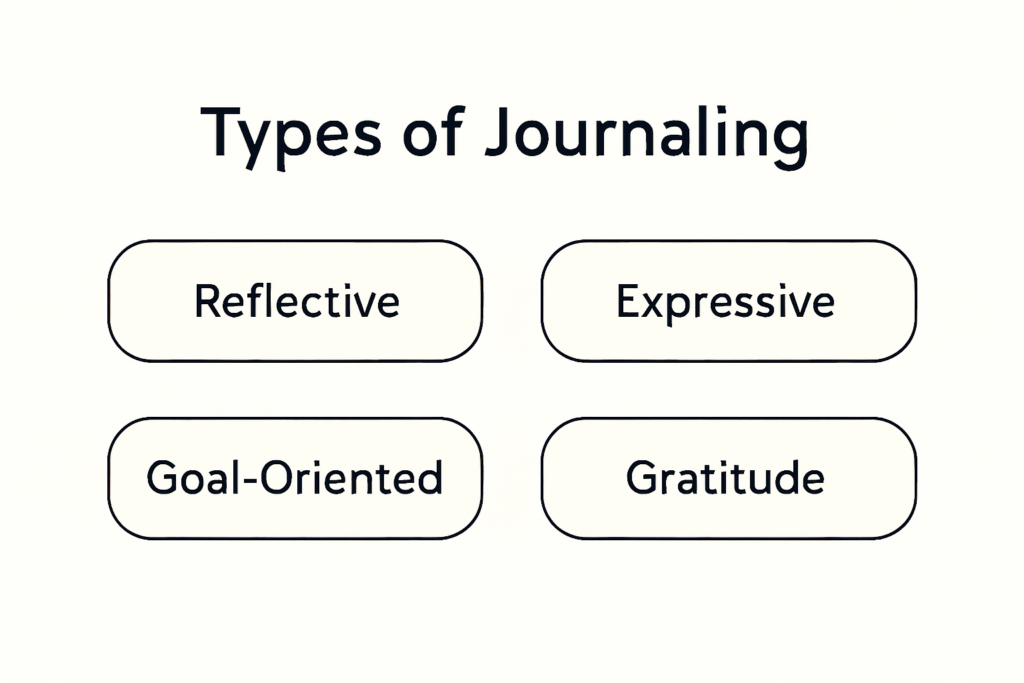
There is not a right or wrong way to journal. In fact, there are quite a few different types, so finding the best way that works for you should be easy. Let’s take a look at some of the different types:
Free-writing
Free-writing is exactly how it sounds. Set a timer for 2-5 mins and write. Don’t worry about grammar, spelling, or censoring yourself. Just write. Continuously. Write what you are thinking at that moment and don’t stop until the timer goes off.
Stream of consciousness
This type of writing is a form of free-writing but is more raw, unfiltered, unorganized, and uninterrupted. It’s messy, unorganized and the closest thing to “thinking on paper”.
Prompts
Prompts are extremely helpful in journaling. Indeed, deep reflection prompts are designed to slow the mind, widen perspective, and help someone meet themselves more fully. In contrast, short structured prompts can give just enough direction to focus the mind without overwhelming it. There are many sites out there with prompts. I have included a few below:
https://www.joyfulthroughitall.com/journal-prompts-for-self-healing
Bullet Journaling
Bullet journaling is a flexible system for organizing your life using short, structured notes — “bullets” — instead of long-form entries. It blends planning, reflection, and creativity in one place.
Goal or Action Oriented Entries
This is a style of journaling where you move from reflection into direction — turning insight into something you can actually do. To say nothing of the fact that it is structured, intentional, and designed to help you create momentum rather than stay in your head.
Reflection
Journaling is one of the simplest, most accessible forms of self‑care — a quiet space where your thoughts can soften and your inner world can breathe. With that in mind, if you’re curious, try it for just one week. A few minutes a day, nothing fancy, simply showing up with honesty and a pen. As you write, notice the subtle shifts: a little more clarity in the mornings, a little more calm in the evenings, a little more emotional resilience growing in the spaces between your words. Small pages can create big changes, and you might be surprised by how gently they begin to steady you.